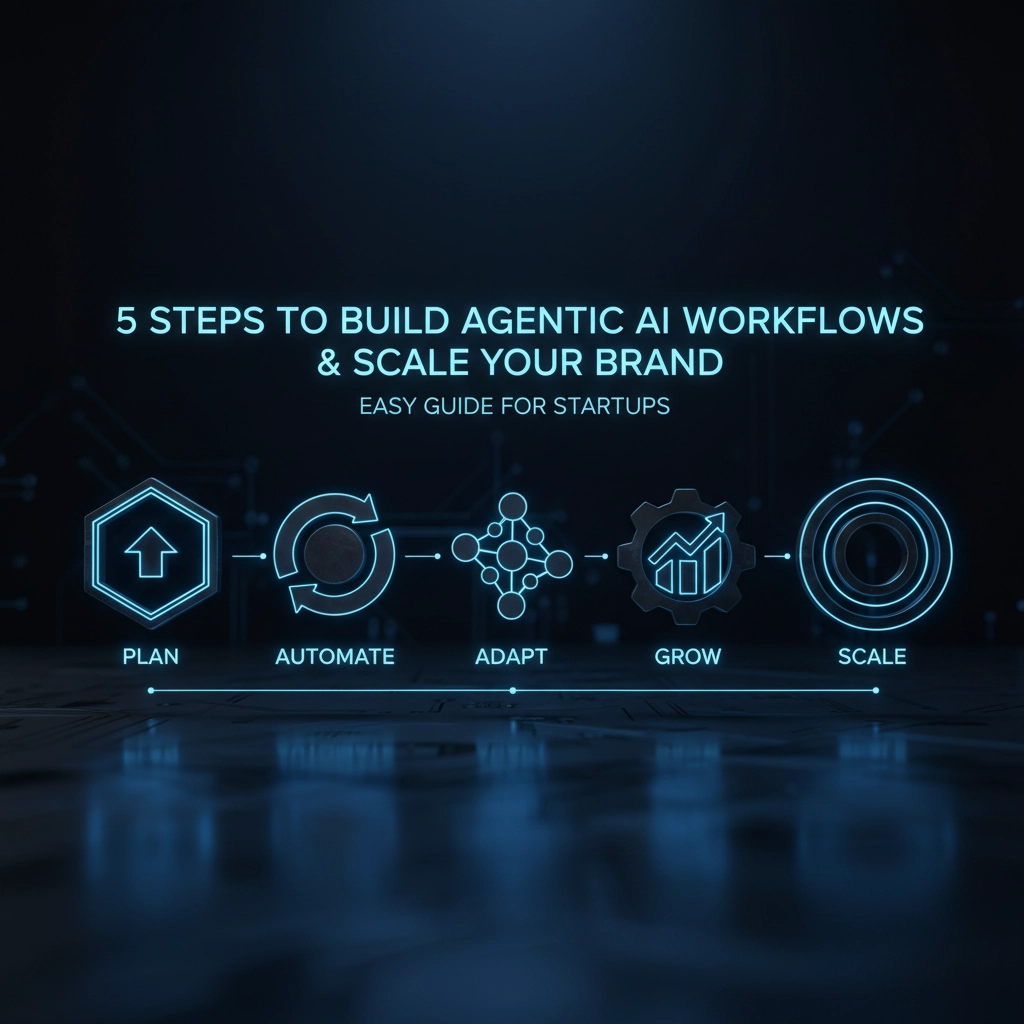
5 Steps How to Build Agentic AI Workflows and Scale Your Brand (Easy Guide for Startups)
AI-powered workflows hero
Your startup's growing fast, but your team isn't. Sound familiar? You're drowning in repetitive tasks—social posts, customer emails, design requests, data entry—while the important stuff (like actually growing your business) gets pushed to tomorrow's to-do list.
Agentic AI workflows aren't buzzwords. They're your ticket to a digital workforce that runs 24/7, doesn't take sick days, and scales with your ambitions. These systems don't just follow instructions—they think, plan, and execute complex tasks autonomously. And you don't need a CS degree or Silicon Valley budget to start.
Step 1: Start With One Problem Worth Solving
Don't automate everything at once—that's how budgets burn and momentum stalls. Pick one specific, repetitive process that's eating time. The sweet spot:
- Multi-step (not just "copy this text")
- Rule-based (you can explain the logic)
- High-volume (daily or weekly)
- Currently manual (a person does it)
Example: instead of "automate marketing," try "auto-create Instagram posts from our blog and schedule them at peak times."
Define success up front: save 10 hours/week? 50% faster lead response? Double social output without hiring? Clear metrics prove ROI.

Agent team planning
Step 2: Design Your AI Agent Team
Treat agents like specialized employees—each with a job, tools, and authority.
- Single-agent start: one agent handles research, writing, formatting, but waits for approval.
- Multi-agent evolution: research → write → SEO → schedule, passing tasks like a relay.
For each agent define role, tool access, decision boundaries, and how it communicates. Specialists outperform generalists.
Step 3: Build the Foundation: Tools and Connections
Agents are only as good as what they can access. Connect to:
- Website/forms (lead capture)
- CRM (customer data)
- Social platforms (publishing)
- Design tools (visuals)
- Email platform (sequences)
- Project management (tracking)
Start with 2–3 key integrations tied to your use case. Use APIs or no-code bridges (Zapier, Make, Airtable). Give agents the same access a new hire would need.

Integrations powering automation
Step 4: Program Intelligence and Guardrails
Your agents need to think, not just execute.
- Task decomposition: break big jobs into steps (analyze → ideate → create → schedule → monitor).
- Decision logic: if engagement <2%, try new hashtags; if >5%, repeat winning themes.
- Self-improvement loops: review wins/misses and adjust.
- Human oversight: approvals for brand-sensitive or high-stakes actions.
- Quality controls: checks for accuracy, voice, and polish.
Train them like a new teammate: clear examples, boundaries, and check-ins until reliable.
Step 5: Test, Measure, and Scale Smart
Launch small, learn fast.
- Pilot: run one workflow on a slice of the work (e.g., 20% of posts or one channel of leads).
- Track: completion rate, time saved, quality consistency, error patterns, cost efficiency.
- Iterate: expect v1 to be rough—use real data to refine behavior and access.
- Scale: add the next automation only after ROI is proven and documented.

Measuring and scaling impact
The Startup Advantage You Can't Ignore
Small teams win here: fewer stakeholders, faster decisions, more experimentation. The compound effect is real—one workflow saves 5 hours/week, the next saves 8, the third 12. Suddenly your 3-person team outputs like six.
While competitors debate AI strategy, you can implement this month. Your customers get faster responses and better experiences while your team focuses on strategy and growth.
Ready to build your first agentic workflow? The biggest mistake is waiting. Start with one process this week, then scale from there. Your future self will thank you for every task you never do manually again.
👉 Let's talk about putting agentic AI to work for your brand.