Are Design Agencies Dead? How AI Tools Like Canva Are Changing Everything (And Why You Still Need Experts)
The headlines are everywhere: "AI will replace designers." "Canva kills creative agencies." "Anyone can design now." The reality? Design agencies aren't dead—they're evolving into superagencies where AI amplifies human creativity instead of replacing it.
Creative teams that integrate AI are seeing 3.7x average ROI, with top performers hitting 10.3x. Timelines are shrinking from six weeks to two while producing more variations. But the efficiency stats miss the point: the real shift is what agencies do and how they do it.
AI-enabled creative workflow
The Great Workflow Revolution
What used to take weeks now takes hours. Ideation that consumed half a day is done in under an hour with AI assistance. Clear Channel Outdoor cut intake time by 60%, saving 15 hours per request while handling 2,500+ monthly asks.
The modern five-stage workflow looks like this:
- Stage 1: AI analyzes briefs and market data to surface campaign angles
- Stage 2: Generative AI explores multiple creative directions fast
- Stage 3: Specialized tools generate specific assets and variations
- Stage 4: Human creative directors refine and elevate the outputs
- Stage 5: AI-powered testing tunes the winning versions
AI handles the heavy lifting. Humans supply the strategic thinking, taste, and narrative that make the work resonate.

AI speeding up creative production
Why "Anyone Can Design" Isn't Actually True
Canva democratized asset creation. AI can draft logos, layouts, and graphics in seconds. But creating design assets isn't the same as solving design problems. AI needs strategic direction, creative judgment, and domain expertise to produce work that moves people.
61% of agency pros worry about AI's impact, yet the answer isn't avoidance—it's upskilling. 41% say AI fluency is now essential for career longevity. Companies adopting agentic AI see 6–10% revenue lifts, but only when experts deploy it with intent.
Think of it like Photoshop: having the tool doesn't make you a photographer. Access to AI doesn't make you a brand strategist.

Human + AI collaboration for brand systems
What Agencies Provide That AI Tools Cannot
The smartest shops aren't competing with AI—they're building on it. Brand language models layer fonts, colors, tone, and IP onto base models so creative is personalized and on-brand. 69% of leading agencies have scaled AI for performance, spotting patterns competitors miss.
But the moat is still human:
- Strategic brand positioning in crowded markets
- Audience psychology and behavioral insight
- Risk management and QA across every touchpoint
- Change management as brands scale and evolve
- Ongoing consultation that adapts to market shifts
AI can spin 100 logo variations. It can't decide which one will convert for your exact audience, market, and growth stage.
The Real Threat (And Opportunity)
The risk isn't AI itself—it's ignoring it. The agencies thriving in 2025 combine three things:
- They treat AI as transformation, not a sidecar.
- They keep human creativity at the center while using AI for speed.
- They invest seriously in training and change management.
McKinsey calls the future model the superagency: AI as the ultimate "what if?" engine, expanding possibilities while humans steer.
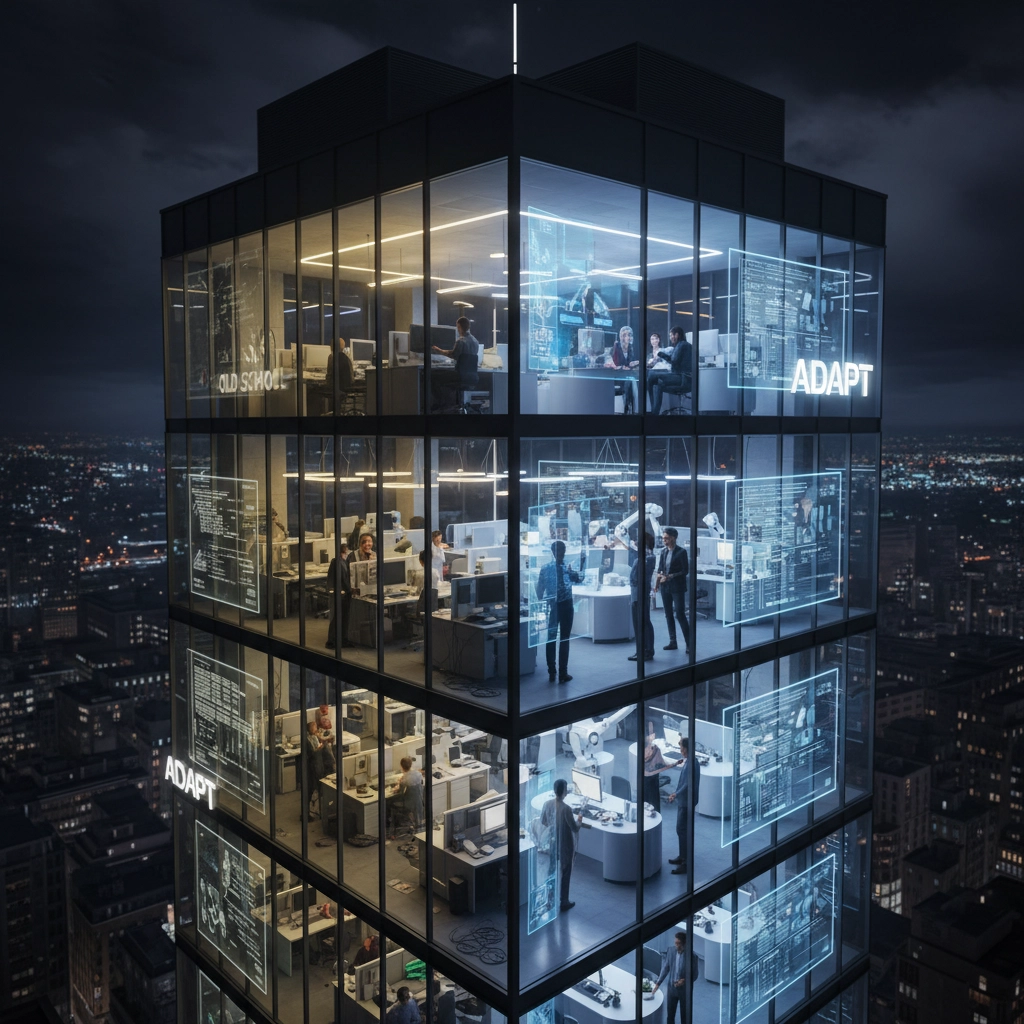
Superagency model: human strategy with AI acceleration
What This Means for Your Business
Use DIY tools like Canva for quick social graphics and simple templates. But if you need brand strategy, differentiated positioning, and systems that scale, you need human expertise enhanced by AI.
At Loom Design, we run a hybrid model. AI accelerates research, multiplies creative variations, and streamlines production. Humans set the strategy, direct the creative, and ensure every deliverable is on-brand.
The Bottom Line
Design agencies aren't dying—they're evolving. The winners blend human creativity with AI efficiency to deliver better outcomes, faster. For businesses, that means stronger design, clearer strategy, and more value.
Ready to see what AI-enhanced design expertise looks like? Let's talk about how this hybrid model can accelerate your growth.